This is where I have my doubts. I think Disney is more into making a show if it than really, truly cracking down. I think they want to make a few examples of people, curb the commercial renting market and hope that in turn curbs the complaints.
Not saying what you’ve broken down isn’t a very logical way for Disney to handle this. I just don’t know if Disney IT has it in them (at this point).
But who knows. I don’t think Disney can look at a confirmed reservation and link it to a specific booking in their system, can they? Scraping the net would be a great tool to find the pattern but I don’t think they could target a specific reservation just based on that.
So for people renting in the near future I don’t think there is a concern that the reservation would be canceled by Disney.
Are cease and desist orders public record (if Disney does what you suggest)? So we, as the general public, could find out which company or owner is in jeopardy? That would be helpful too.
This was my thinking.
I run into so many issues with just basic functionality with Disney IT (don’t we all?) that I can’t see them implementing Machine Learning to curb this problem. I don’t know about others, but I’ve been running into an issue where, when on the DVC site, I’ll frequently just get a page of HTML rather than actually showing the correct information. How in the world can something so entirely basic not work? (I can sometimes just reload the page to get it to work, but sometimes I have to back out of the transaction I was in the middle of and start over to get it to load properly.)
Yeah. Disney IT doesn’t have it in them to solve this problem with any level of technology. 
No, because it’s between DVC and the member.
If they issued one to a company that was not themselves a member by way of an LLC, I suppose it’s possible it might be made public either by DVC or a leak.
I was thinking they would look at primary guest vs. DVC owner and how often that doesn’t match. I KNOW it happens sometimes/often/regularly but it’s certainly an orange flag if it’s happening multiple times.
It could produce a list of all reservations for the same room. They then have lists for every confirmed reservation as of that moment…… and more and more lists every time they run it.
Now what? Check them all for a lead name change, and compile a spreadsheet. See if the same owners crop up over a set period to establish a pattern.
Plus course an owner can also have many different contracts, memberships.
They could do it four times one year because there were valid reasons for them not being able to use them, but not the next year. Or it could use a fraction of their points. Etc etc.
So they need to have defined the parameters which then warrant contacting the owner to find out more.
Realistically can all this be achieved from existing budgets?
Renting points out for commercial profit is already prohibited. And Florida law has been changed to give the management of timeshare enterprises more clout over even owner rights. The point I’m making is that if you identify the specific “bad actors” and have the legal team “discuss” it with them, the commercial renter will either stop the practice or outright sell their points and abandon the business. No need to be deeply granular in identifying specific instances if the majority of repeat offenders are no longer diverting large blocks of points for commercial gain. That reduces Disney’s hotel competition. That is Disney’s true goal here, not to go after the little guy. Besides, that ‘little guy’ is sometimes cast members.
Agreed that Disney IT is incapable of implementing something like this. Disney would probably hire one of the many AI start-ups offering ML training services. Once the model is built/trained, running it would be within their abilities and internal systems capabilities. Keeping the proprietary member info secure outside of Disney’s systems is something else. A very strict NDA would probably be required.
I agree with this.
I don’t know if they need to use AI or any tech tools whatsoever. Whatever method they use, the process is pretty simple:
- Identify a handful of egregious offenders
- Make an example of them either through lawsuits, cease and desist letters, etc.
- The majority of major players will exit the business due to the fear of being the next target
- Significant reduction in commercial rentals without impacting individual owners
Agreed. As long as there isn’t some sort of automatic response like cancelling reservations or anything. An owner can have a reason for having rented out points for multiple years in a row that isn’t necessarily “commercial”.
I don’t think it is realistic to except this level of work to solve the problem. I do think they will target a few much larger points owners (thousands of points) and make an example out of them. Similar to what they did recently with banning a few well know your operators that were abusing the DAS policy. They didn’t root them all out. They just targeted some higher profile ones in a very short amount of time. The story wrote itself and that business is squashed. They did have to change some rules moving forward. But changing up DAS is 5th grade work compared to the complexity of DVC.
I’m not so secretly hoping this happens.
Targeting the sale of confirmed reservations is probably easier than targeting the commercial renting of points. But I guess it’s still possible. IMO the confirmed reservations (the ones intentionally grabbing the highly sought after rooms at popular time at the 11 month mark for 1 or 2 nights at a time in order to resell them)are the problem.
I know that (elsewhere) it’s been said that there are Facebook groups that list numerous confirmed reservations for key dates.
An easy target? I don’t know. Is a Facebook group an entity that can be held liable?
It is possible it’s run by one of the LLCs that could be targeted by DVC. But equally it could be just a group that DVC members join where they are encouraged to make reservations and list them.
Could DVC go after the named moderators through their FB account? Even if they could find out actual identities, are they breaking the rules - they’re likely to be DVC members but I’m not convinced they can be held to account for others making reservations.
The DVC rules apply to members using their own points. If they issued a cease &desist notice to a FB group, wouldn’t others just set up a new group?
I think they will go after big businesses, not a Facebook group. They might be able to identify the business partially through a Facebook group. But I don’t think a random moderator has anything to worry about.
I agree 100%.
But I just don’t see how DVC can police it. How do you prove intent? How do they identify the owner of a listed rental and track the outcome?
If they try convoluted rules they just catch ordinary members along with the opportunistic members.
They probably don’t need convoluted rules, they just need to find the RIGHT combination of simple rules.
For example, (and I’m sure there is a hole in this, but just illustrating my point), they could set a minimum number of points owned as one filter, and then look at the percentage of those points that were not used by the owner directly. (Maybe it is 30%, 50%, whatever). That won’t catch everyone. But it will catch a lot.
Yes and no.
Under changes to FL Condominium laws, they cannot make changes that restrict owner’s rights beyond what was stated at the time the Condominium units first went on sale
WITHOUT a vote of members. And then, even if passed, it only applies to those who voted in favour.
All DVC Resorts prior to the Cabins at FW are Condominiums.
Example of 1 I follow: these are some of the first posts that come up. I think this might be DVC rental store. Not sure. Just started following.


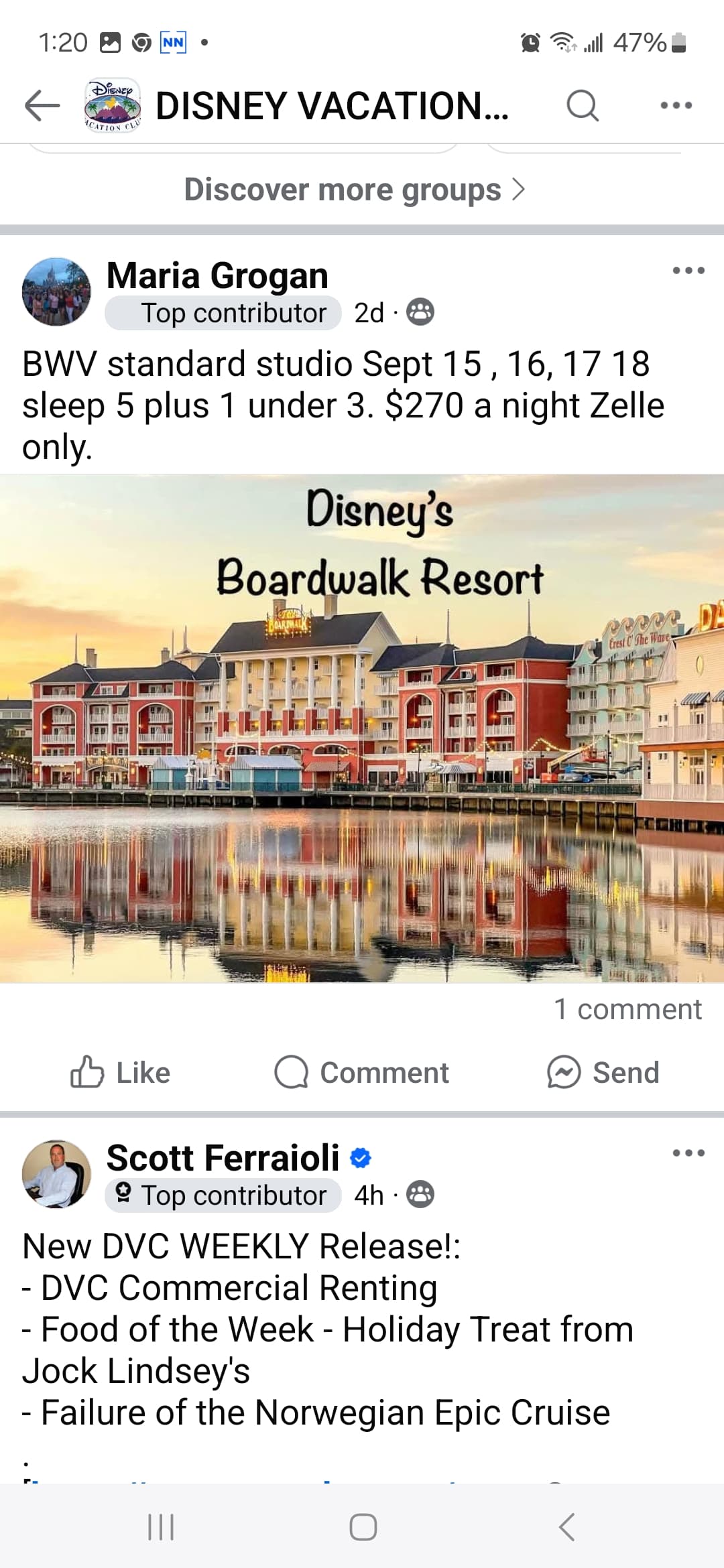
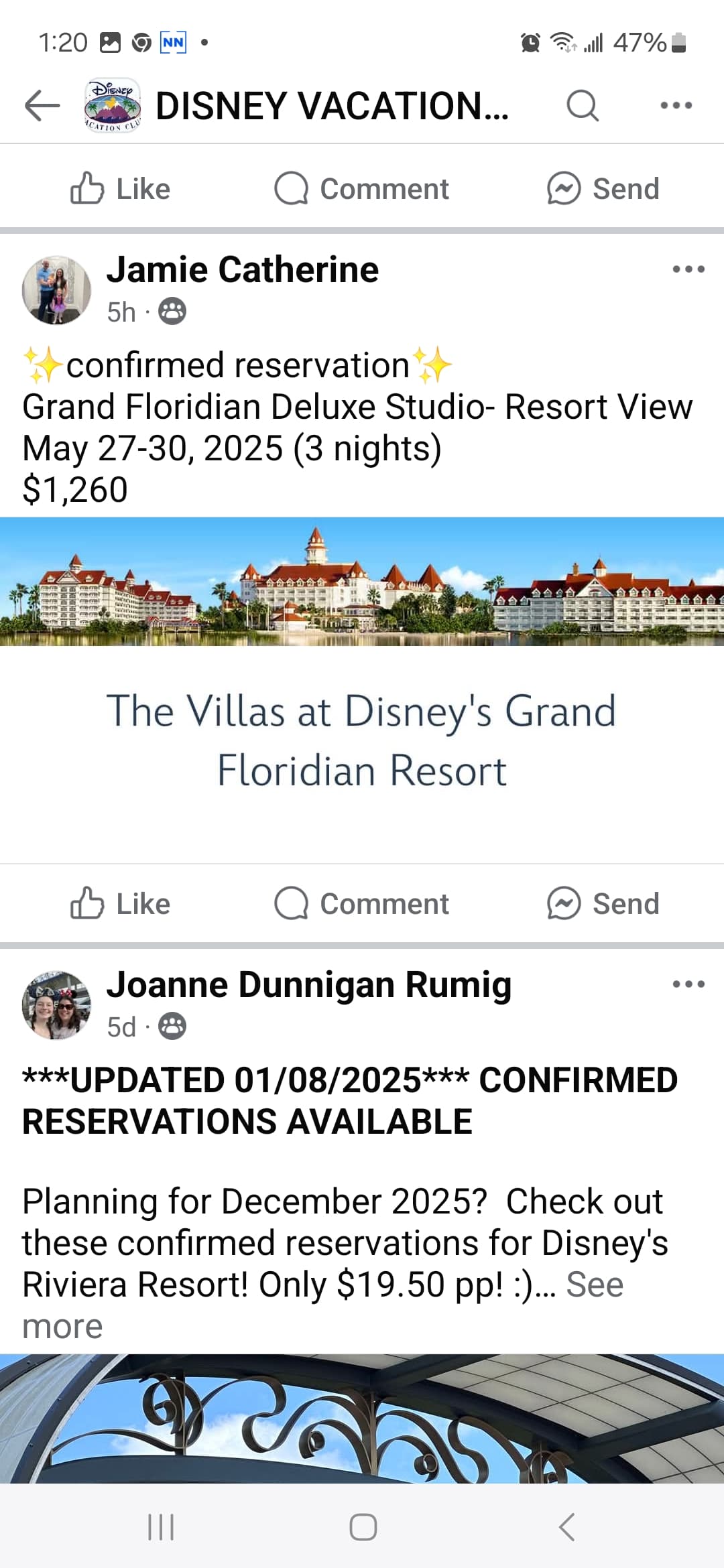
See how one is a “top contributor”. That’s one good way. But this group is private. So Disney would have to plant a mole to see the inner workings.
And that is the biggest hurdle. What constitutes as “commercial”. I’m guessing there has to be some sort of additional criteria other than just having and renting a lot of points.
I don’t know if Disney plans on catching a lot. I think they want to make an example of a few people they (may already) have proof are operating a legitimate business selling reservations. I still hold my position that selling a reservation at a Disney hotel is vastly different than renting out points.
Reading back to the original article, DVS made this exact point: “They own a lot of points and it’s a frequent occurrence.”
And interestingly: Senior Vice President and General Manager Bill Diercksen confirmed that Disney Vacation Club has “added resources to our core team at DVC in order to pursue this and make sure that it is fair” to everyday members. According to Yvonne Chang, Executive Director, Business Operations "[w]e’ve got a whole team of folks focused on this. Hopefully by next year when we have this conversation, we will see some improvement.”
Ahh, so this has a time frame of some sort. I hope it’s publicly broadcasted what they do and when.
Same way Marriott did by exercising ROFR.
They can take the contracts back and place them in the trust…
But units are split across different contracts. They would need to get very lucky to be able to buy back the right contracts to complete whole units.
Also, I don’t know how a Trust would work with only some owners being in it. It would mean 3 separate inventories for a start - owners, trust and DVD.
Remind me why it has to be complete units?
I think I’ve lost the train of this portion of the conversation. I’m not sure what the benefit is for Disney of putting points / units in a trust.