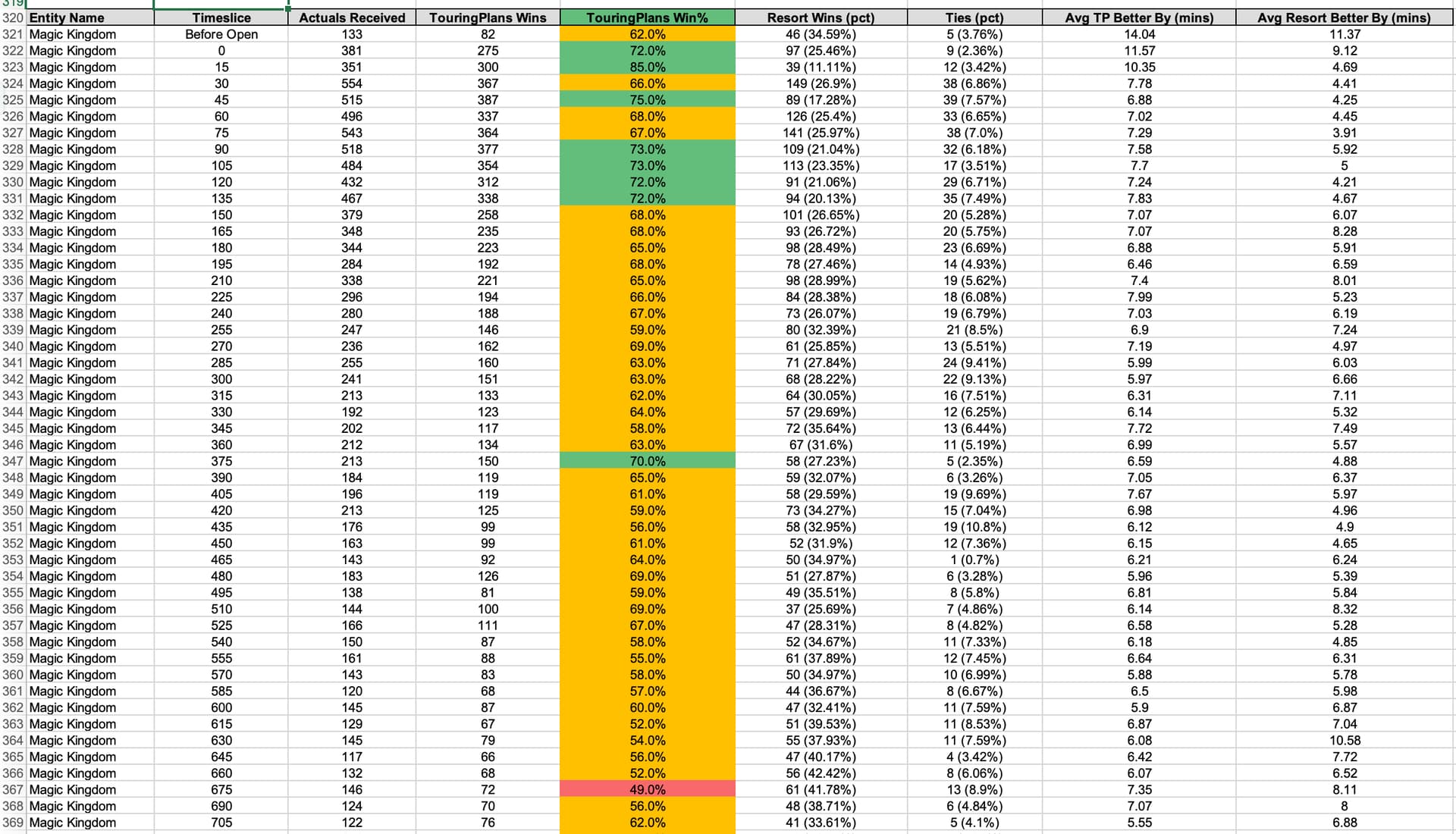
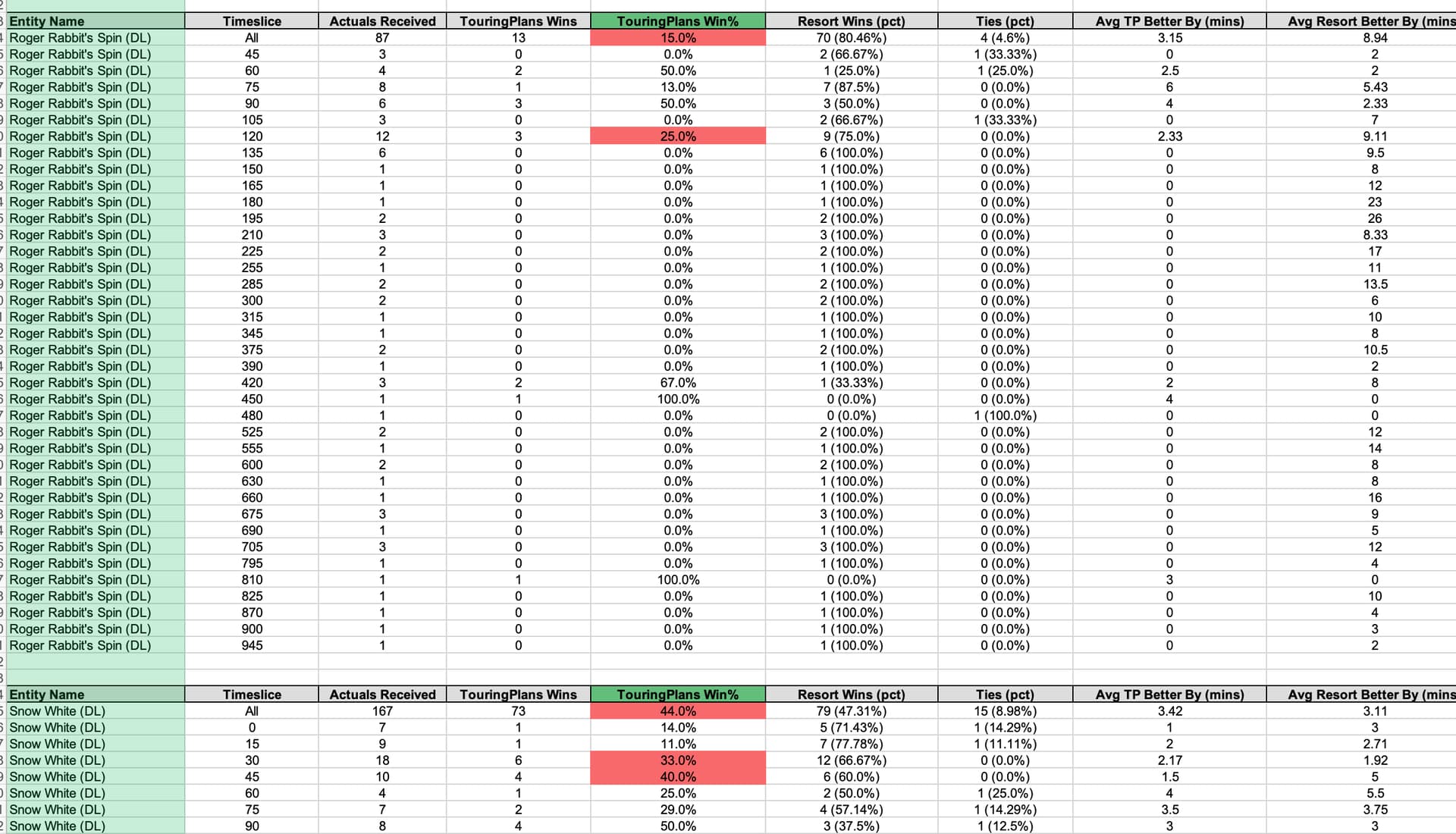
Ah, yes. The intraday process runs every 10 minutes and adjusts today’s forecasts based on what’s happening in the parks.
The intraday process attempts to do this in two ways:
- With the posted wait times we get from Disney
- With actual waits we get from y’all
If we have just posted waits from Disney, we compute the difference between the most recent posted wait and the most up-to-date prediction of that posted wait, to nudge the predictions towards what we’re seeing in the park.
Those predictions are in 15-minute increments, so we predict the posted and actual waits at (for example) 1:00 pm, 1:15 pm, 1:30 pm, and so on. We use linear interpolation (i.e., “draw a straight line”) to get predictions between 1:00 and 1:15. So if we need to compute a wait at 1:08 pm, it’s gonna be pretty close to the middle of whatever the numbers are at 1:00 and 1:15 pm.
When we’re dealing only with posted waits, we use the same actual-to-posted wait ratio for that 15-minute segment that we calculated when we built the models. So if the models say the actual wait is 80% of the posted between 1:00 pm and 1:15 pm, and all we have is posted waits to go on, then we use that 80%.
If we get an actual wait, we re-compute the actual-to-posted ratio and use that instead, for the next 30 to 60 minutes (I don’t recall the exact duration, since I didn’t touch this part of the code).
That 30-60 minutes is our “short delta” - it allows us to respond to sudden changes in wait times, but treat it initially as a temporary thing. It’s primarily useful when rides break down and come back up, or for unusual things like “giant tour group gets in line at Toy Story Mania.”
We also compute a “long delta”, which is the difference from park open until now. We use the long delta for adjustments more than an hour from now.
I toyed with a “very short delta” over the fall, trying to see if using just the most recent wait time for just the next wait time would improve things. It didn’t show a clear advantage so I didn’t do it.
It turns out that the most important things for the intraday adjustments seem to be:
- Getting the initial actual-to-posted wait ratio correct
- Running the intraday adjustments as many times per hour as possible
We model around 300 attractions around WDW, DLR, and UOR. Around 200 of them are “core” attractions, like Slinky, Pirates, etc., with posted wait times that vary significantly.
Each of those 200 attractions starts the day with anywhere from ~60 to ~80 wait-time predictions (we include a bit of time before and after official park opening, in case Disney changes park hours during the day itself).
So every 10 minutes we’re looking at around 14,000 - 20,000 pieces of data to figure out what’s going on in the parks right now. Getting that to happen as fast as possible is something I’m going to work on in 2026.

 Thank you all for your help and comments over the last couple of weeks. I love this community.