I’ve got graphs showing the historical relationship between actual and posteds waits for every WDW, DLR, and UOR attraction.
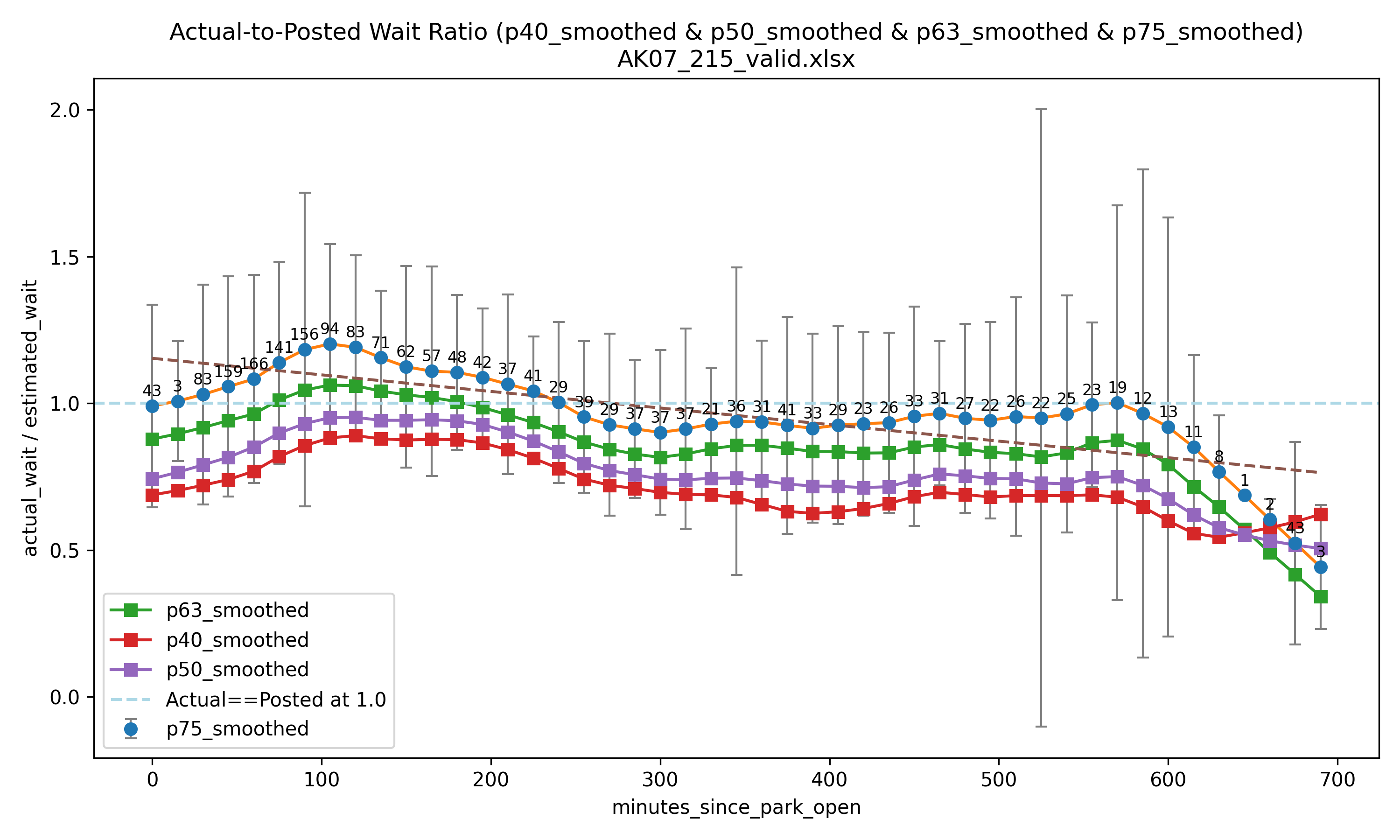
For example, here’s Kilimanjaro Safaris:
The dashed blue line is the posted wait. If every actual wait was EXACTLY the posted wait, every data point would be on that dashed blue line.
Every data point is not on that dashed blue line.
The red line is the 40th percentile of average actual waits, expressed as a ratio of the posted wait.
For example, at 300 minutes after park opening, the 40th percentile is around 0.70. So whatever the posted wait is at 300 minutes after park opening, 40% of those waits will be less than 70% of that number (and 60% will be that or more). So if the posted wait at 300 minutes after park opening is 60 minutes, 40% of actual waits will be 42 minutes or less.
The purple line is the 50th percentile, which means “half of actual waits will be higher and half will be lower.”
The green line represents 63% of actual wait times. So for Kilimanjaro Safaris it’s safe to say that most actual waits are less than the posteds.
The orange line is the 75th percentile.
Here’s Flight of Passage:
For the first half of the day, a significant number of actual waits are higher than the posted waits.
Here’s TRON Lightcycle Run:
Extremely tight ranges. Whatever the posted wait is, is your likely actual wait.
We use these ratios when making days-in-advance wait-time predictions and intraday adjustments.
For what it’s worth, our estimates of your actual wait are better than or equal to Disney’s around 70% of the time. (As you can imagine, I have a daily spreadsheet broken out by resort, park, ride, and time of day.)