This definitely falls in the “usual, but not always” category for me. 
2 Likes
Oh Len, how I wish I could again access these charts again  You know I was just talking with David last week about this historical data and how we lost access with the new website. I know you share the averages, but I think specific data would be helpful for Universal because there is less submissions.
5 Likes
This is soooo helpful! Thank you. I never optimize either but I’ve only ever used it pre-park never in park. Thanks again!
1 Like
super helpful @Bethhampton and @QwertySC ! Thank you!
1 Like
This is true for me as well now.
I did this with my first use of TP in the parks last year. Because I understood that there were intraday adjustments, I optimize after each few as well, to make best use of the adjustments.
1 Like
Thank you for everything you do, Len.
I’m very happy to see this issue being addressed. In September my 18-yr old daughter and I were shocked to experience several times where the TP estimated wait time was much lower than what actually I timed through the app (like 30 posted vs 60 actual), and the timed wait was very close to Disney’s posted! This was the first trip where I felt the Lines wait times to be questionable. I love and depend on the service you provide!
This seems like a very large undertaking, with the steps you posted. Thank you.
4 Likes
This was my experience too. I just created my own work around similar to yoursa: I closed it and reopened it to see the results, otherwise it would never stop processing, even though it was done.
2 Likes
Also, to the prior post about the actual wait being close to what was posted by Disney: that too was my experience. Lines would say the expected wait for a character meet and greet was 10 vs. 20 posted, but it was in fact 20 minutes.
Since we used LL’s for so many rides, I really only used lines to look at rides that didn’t have them (character meet and greets) or rides we didn’t have an LL for.
5 Likes
We’re working on chart upgrades in 2026, with an eye towards bringing those back and adding more graphing features.
6 Likes
An update on progress since last week:
- Issue #2 and #3 (Intraday wait-time adjustments) - I modified the process to look at the last set of forecasts instead of the original set of forecasts. I’m running it on my laptop, and it looks promising. There’s one more step that’s not working on my laptop that I need to get working - the step where we look at each wait time received and figure out whether it’s believable or if we should wait for more data to confirm it.
- Issue #1 (the original forecasts have incorrect actual-to-posted ratios): I wrote code to determine this ratio for every attraction that we forecast, as part of our “build the models” process. This week my goal is to use that information in the “make the forecasts” part of the process. And that’s doable.
A big question to address in Issue #1 is which actual-to-posted ratio to use. The error bars in the graph above are pretty wide, which means there’s not a constant, close relationship. But we have to pick something.
Here’s the same graph expressed as a chart:
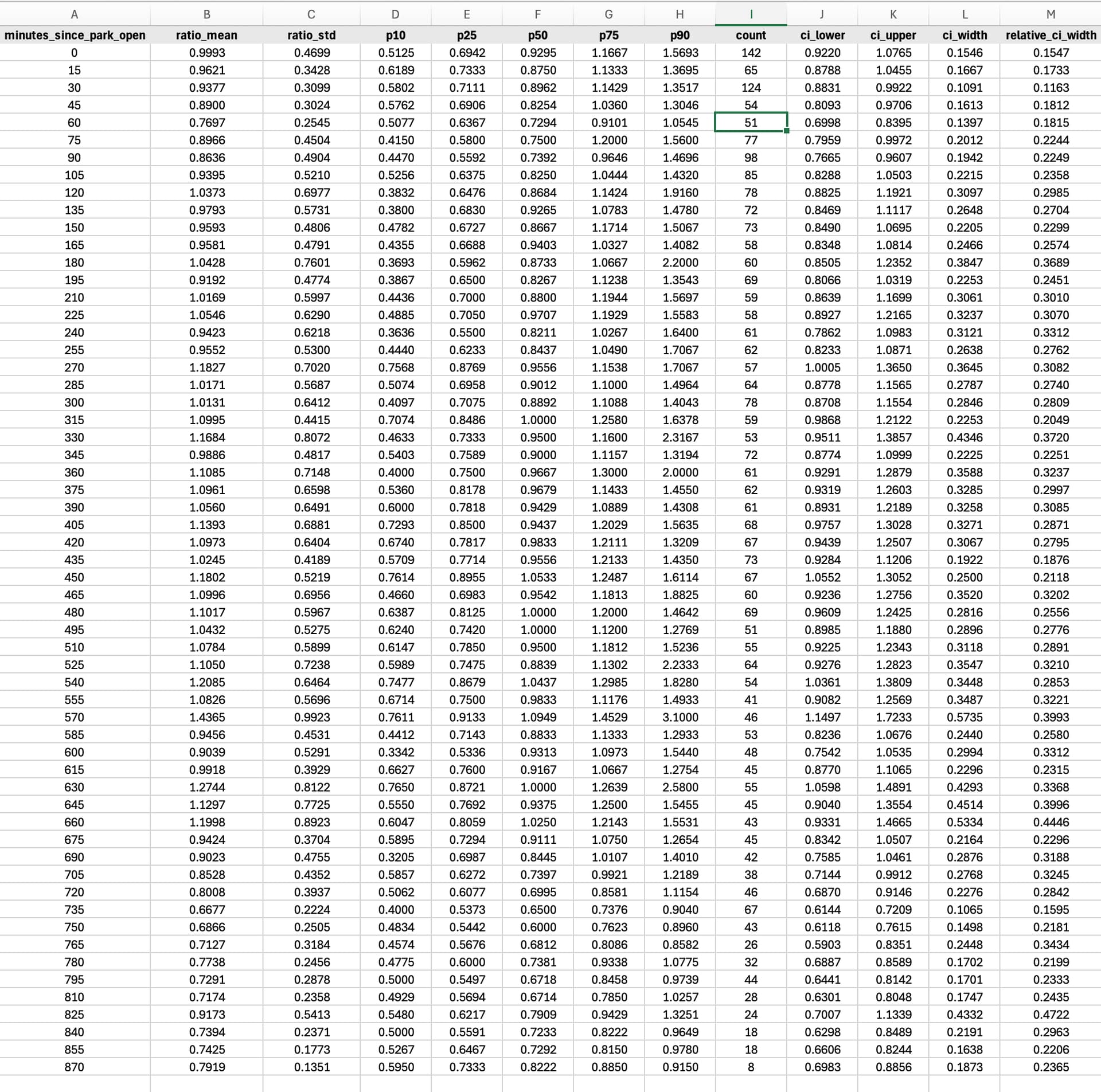
“ratio_mean” is the ratio around the 60th percentile - so 60% of actual wait times at park open (time 0) have a ratio of less than 0.9993. If the posted was 50 minutes, 60% of actual waits would be less than 50 minutes and we’d predict an actual of 49.965 minutes.
That means, of course, that 40% of actual waits would be more than that. And 40% seems like a large number.
The p75 column shows the ratio for 75% of actual waits: 1.1667. So we could, as an alternative, use that number and say that the actual wait is going to be 59 minutes on a 50-minute posted. 75% of actual waits would be less than that.
The issue with over-predicting actual waits is that it gives y’all a slightly more pessimistic view of what you can accomplish in a day. But maybe 9 minutes per attraction isn’t terrible.
 So the question is: how pessimistic should the days-in-advance forecasts be?
If we use the 50% ratio, half of actual waits will be less, and half will be more. That’s the optimistic scenario.
If we use the 75% ratio, 3/4ths of actual waits will be less than that number. That’s the moderately pessimistic scenario. Or the “pleasantly surprised” scenario, for those of you who view the glass as half-full.
We could also use the 90% ratio, which would be the fully pessimistic ratio. But almost all waits would be less than that.
Let me know what y’all think about this, please.
7 Likes
I would rather you be mostly pessimistic. I think that this is the classic, under-promise and over deliver scenario. Everyone feels good if they are ahead of the touring plan and can take an extra long lunch or blow bubbles, etc. But if you are behind the TP then it just leaves a bummed out feeling that you are missing out.
11 Likes
I agree. On chat we always advise to “expect high crowds and be thrilled if you are wrong”. Lower than expected is always a great thing.
9 Likes
Much appreciated
2 Likes
“Run naked through the EPCOT fountains” - whatever floats your boat.
11 Likes
Do not give my sons ideas please.
9 Likes


 stop doing this statistics stuff, @len. It’s very triggering.
2 Likes
I think I would lean towards at least the moderately pessimistic - under promise, over deliver will make more dopamine flow than people being on the losing end of a 50/50 and getting their Mickey ears in a bunch.
Also: Dopamine Flow was my favorite Enya song.
8 Likes
Secrete away / Secrete away / Secrete away
10 Likes
I may have said on a podcast that Laurel’s doing a Masters in statistics at Columbia. Did you know you can take math classes that … don’t involve numbers?
Incantations! Sorcery! Why, it’s witchcraft, I tells ya’!
10 Likes